The Biggest Takeaways From the Google Search Algorithm Leak
VELOX
•
5
min
SEO, Digital Marketing

Let’s Connect!
Book time with our team, or send the details and we will come back with a revenue forecast for your brand.
Within the digital marketing industry, there’s a hunger for accurate information about how Google Search works. SEO pros are always looking for verifiable insights into the nitty-gritty details in hopes of improving their SEO strategy.
Is Google's Search Algorithm a Secret?
Sure, they publish plenty of guidance to help marketers create high-quality websites and publish content capable of ranking well, but Google typically sidesteps the particulars, speaking instead in broader themes and concepts.
So when something like Google’s Content Warehouse API leak occurs, it’s going to get everyone’s attention. This published documentation comes from inside Google’s Search division, and Google has confirmed the authenticity of the huge algorithm leak.
As if the unintentional release of 2,500 pages of API documentation wasn’t bad enough, the information contained within refutes a number of the claims Google representatives have made in the past.
If you’re a digital marketing manager, regardless of industry, learning about the information contained in this leak is well worth your time. This level of visibility into the mechanics behind Search is unprecedented. It will help you better understand how to adapt your online presence to boost KPIs and drive revenue growth.
Let’s start by looking at what exactly the leak covers. Then, we’ll discuss what the newly uncovered data does, and doesn’t, tell us.
The Google Search Algorithm Leak and Its Significance
The leak itself is a behemoth: over 2,500 pages of API documentation from inside Google’s internal Content API Warehouse, containing 14,014 attributes.
Evidently, the leak came from GitHub. It seems someone at Google left the front door open on this one, accidentally publishing the documentation from late March 2024 to early May and ultimately removing it on May 7 2024.
The information in this leak was compiled for use by the folks at Google Search. It was made public without the context necessary for outsiders to make complete sense of it.
Before diving into the specific attributes detailed in this leak, it’s important to cover what this leak is and what it isn’t.
Take a moment to consider the “white whale” for digital marketers and SEOs: a leak that contains not just ranking factors but also weighting as it pertains to individual scoring functions.
In layman's terms, we want the comprehensive list of factors Google looks at and how significant each of those factors is for ranking.
That is not what’s covered in this latest leak.
What we have falls far short of the dramatic reveal many SEOs are waiting for.
While that may sound deflating, this new information is certainly intriguing, and the leak is still significant. It does contain numerous details about stored data for things like user interactions, content, linking, and other elements. Many of these are even ranking factors.
However, there are open questions about which of these features are still in use, which have been retired, were only used internally, or were never deployed.
However, we can surmise the leaked documentation was current as of at least August 2023 and perhaps even up to March 2024, when it was first erroneously published.
In short, this leak isn’t the look beneath the hood many had hoped for. But it does offer more visibility into Google Search than we’ve seen in at least 25 years.
That alone is a big deal.
Unless your background is fairly technical, the documentation itself likely isn’t of much direct use to your digital marketing efforts. However, the broader takeaways are vital for everyone to know.
What Is Google's Search Algorithm Based On?
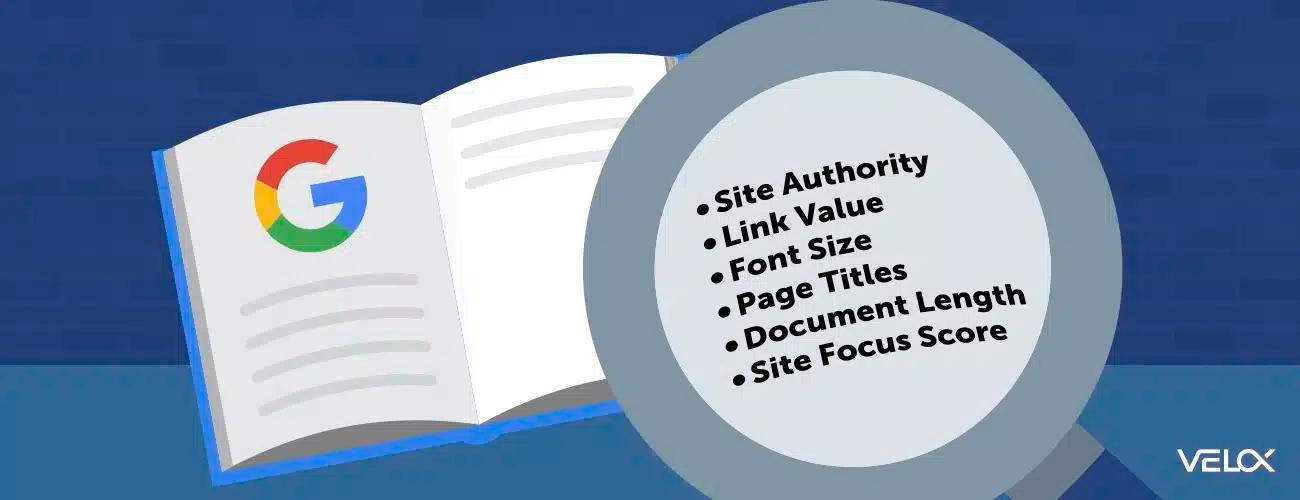
Building a winning website requires considerable thought about the site itself, not just products, funnels, and conversions.
In fact, it’s worth thinking of your website as your brand’s flagship product. After all, it competes against other websites in your industry, just like your products or services. That’s why properly conceptualizing the role of your website is key to building an effective digital marketing strategy.
Here’s a look at some of the most prominent ranking features covered in the Google Search algorithm leak and their impact on your digital marketing efforts.
Domain and Site Authority Play a Role in Ranking
Google spokespeople are on record saying Google doesn’t create, store, or use domain authority scores. But thanks to the leak, we now know that “siteAuthority” exists, which vindicates many SEOs who have believed domain authority plays a role in rankings.
siteAuthority is one of the Compressed Quality signals stored for each crawled document.
How does Google use siteAuthority? What impact does this score have on ranking? We don’t know for sure, but one might assume that the better your site’s authority, the better you stand to rank.
It’s also never a bad thing to be an authority in your industry, and even before this leak, striving to increase your site authority should have been a long-term, ongoing goal.
This leak confirms that reputation matters, which has long been a core tenet of effective SEO.
Our Advice:
- Strive to be the expert in your industry through informative content that provides in-depth information with supporting subtopics to answer even more niche questions.
- Use verifiable facts and statistics to support your claims, ensuring you’re a trusted resource for searchers.
- Prioritize authority in your link building strategies, focusing on industry-relevant sites with high domain authority.
Backlinks and Link Building Are More Important Than Ever
Backlinks are critical to establishing site authority. They also help Google understand a page’s relevance for a given Search query.
sourceType, a metric revealed in the API leak, confirms Google analyzes the quality of linking pages and assigns a backlink value based on this evaluation.
That’s to say that within your backlink portfolio, links from high-ranking sites like The New York Times would do much more to improve your ranking performance than links from lesser-known sites.
However, don’t take this to mean every successful link building strategy is comprised of only high-authority sites. Instead, a holistic, natural mix of high- and low-authority backlinks can often drive rankings the best since this avoids looking manipulated or “spammy.” In general, however, quality is always going to beat quantity.
You don’t want all “nofollow” or all “dofollow” links, either. An effective backlink profile should include a variety of links with an omnichannel focus: social bookmarking, image sharing, blog posting, and more.
Again, SEO pros have known this for quite some time, but seeing it confirmed in this way is valuable for agencies and clients alike.
With the recent broad-scale introduction of generative AI tools, the idea of using fast, cheap AI-produced content for link building may seem appealing. Plenty of people have already experimented with this approach, and overall, they’ve been disappointed.
Remember, spam is spam, regardless of how it was produced, and high-quality content is the only way to generate high-quality results.
Don’t neglect internal linking, either. By strategically linking your pages to one another through your navigation menu, on-page anchor text, and buttons, you minimize click depth and help Google better understand your site’s hierarchy. (Click depth is the distance, measured in number of clicks, between a given page and your site’s home page.)
By making your site more accessible to search engine crawlers and users alike, you can enhance its visibility and create a superior UX.
Read more insights
Organic Search, Paid Media, AI Search, and revenue intelligence from the VELOX team.
View All Articles